 Tokenwright
Senior operators. Quoted in minutes. The velocity layer for Salesforce Commerce Cloud.
The backlog item that's been stuck for months can ship this week. One senior operator, with deep context on your entire codebase, quotes it against your actual code in minutes and delivers a merge-ready PR in days. And because the models keep improving, every engagement gets sharper than the last.
Four stages. Every request. Every time.
From a one-line bug fix to a multi-week feature, the flow is the same — quoted in minutes, merge-ready PR in days.
Request
You submit a plain-English description of what you want. "Add Apple Pay to checkout." That's the brief.
Specification
The scoping agent reads your actual code and returns the scope, approach, firm token quote, and risk flags. You approve before any work tokens are reserved.
Quote in minutes, not weeksBuild
AI generates the change. One named senior operator reviews, refines, and validates — with full codebase context and the experience to make architectural calls.
Delivery
A clean, documented, tested pull request lands in your repo. Your incumbent SI merges and deploys on their schedule.
Three places teams lose time.
Most e-commerce directors work with capable teams who genuinely want to ship. Good ideas still wait, though — usually because of distance between the people writing the code and the merchant who needs it, and how much context travels with each request.
Organizational distance
Requests pass through several hands before they reach the developer who builds them.
Context thins at each handoff, and the original intent gets harder to trace.
Planning overhead
Refinement, estimation, planning, scoping — all valuable, but it can add up to weeks before a developer touches code.
Your roadmap can end up moving at the speed of meetings rather than the speed of your business.
Context gaps
Estimates are often built from meeting notes rather than a deep read of the actual repository.
When full codebase context isn't on hand before a quote, even great teams are working partly from guesswork.
Code is no longer the slow part. Your roadmap shouldn't be either.
AI didn't just make developers faster. It collapsed the gap between intent and working code — which means the slow part of delivery has moved.
Estimation, planning, and scoping made complete sense when writing code was the slow part. Now that working code comes faster, there's room to spend less time planning and more time shipping.
Most system integrators built their teams and rhythms around that earlier shape of the work — and they're genuinely good at it. Layering a new model on top of an established, well-run practice simply takes time.
Tokenwright was built for this new shape from day one. AI gives our operators instant, deep context across your entire codebase — depth that used to take months to accumulate. Seniors handle the judgment; the engine handles the volume. And because the underlying models improve roughly quarterly, every engagement gets sharper, automatically, with no renegotiation.
We're not here to replace your SI. We're the velocity layer that sits on top — making the work they already do easier.Your codebase, understood. Even when you're not spending tokens.
Once you're onboarded, the same understanding that prices your requests is available to your internal team as a set of agents — five live today, ten more coming — part of the engine, never separate products to buy.
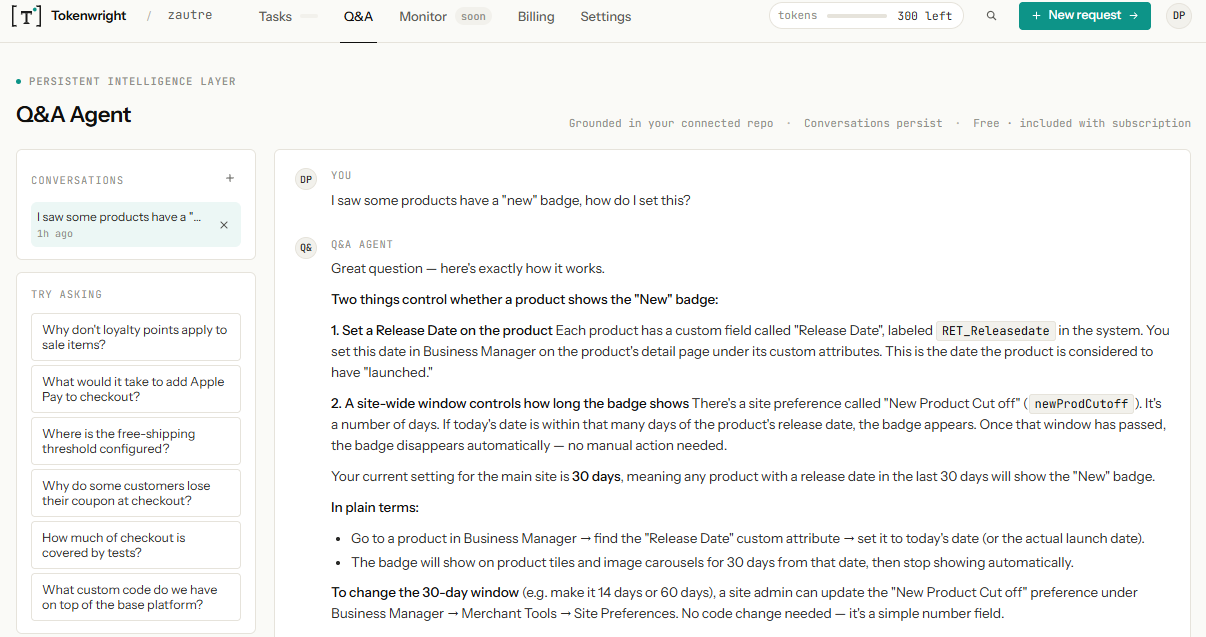
Q&A Agent
Merchandisers, PMs, and IT leads ask plain-English questions about how your store actually works. "Why don't loyalty points apply to sale items?" "What would it take to add Apple Pay to checkout?" Answers come back grounded in your real code — in plain language, not someone's best guess.
- Why don't loyalty points apply to sale items?
- What would it take to add Apple Pay?
- Where's the free-shipping threshold set?
Monitor Agent
Watches your instances' logs and your repository for errors, anomalies and security risks, and reports each issue in plain language. Ask it to investigate and it reads your code and writes a finding: what is happening, the root cause, and whether there is a fix or a workaround. Turning that into priced work is one request away, quoted like any other. Included with every account.
- Error rate spike, /cart route
- Slow query, loyalty_balance.ds
- Auth anomaly, admin pipeline
SEO & AI Discoverability Agent
Checks that your pages are discoverable the way you intend — whether a shopper arrives from a search result or an AI assistant's answer — and traces every gap to the part of your code that causes it. Metadata, structured data, redirects, sitemaps and canonical drift, for search engines and AI assistants alike. Run it on request against any page you name.
- Product pages carry no machine-readable price
- AI crawlers blocked at the edge, not in robots.txt
- Canonical points at a page that 404s
Best Practices Reviewer
Reads your codebase the way a senior B2C Commerce architect would — how it extends the reference storefront, calls out to partners, caches, runs its jobs — and scores each area against what Salesforce recommends. Every finding says what the platform recommends, what not following it costs you and whether we can fix it. Any finding can become a request.
- Checkout copied from the reference storefront
- Partner call made outside the Service Framework
- Business logic living in ISML templates
Security Auditor
Reads your code the way an attacker would: what someone with no account, a signed-in shopper or a forged message from a partner could reach, and what they could read, change or pretend to be through it. Secrets in code, unprotected routes, unsafe handling of shopper input, exposed customer data and vulnerable dependencies — found before someone else finds them. It reads the code and never touches your live store.
- Credential committed in a config file
- Order lookup without the order token
- Shopper input rendered with encoding off
Ten more on the list
We ship new agents continuously — each a new, automated way to keep your storefront sharper. Ten are on the list today, and the Agents page in your workspace lets your team vote on which we build next. Every one reaches existing subscribers without renegotiation, the moment it's ready.
- Performance Agent
- Accessibility Agent
- Localization Agent
- Promotions Agent
- Data Consistency Checker
- Config Drift Agent
What a Managed Token actually is.
Velocity layer first. Full stack when you ask.
You can stop at any stage. We don't pitch consolidation — we earn it.
Velocity layer
Subscription alongside your incumbent SI. We clear the backlog and deliver clean PRs. They keep production, monitoring, and pager duty. Zero political fight, no procurement gate.
Shared operations
As the Monitor Agent earns trust on the production side, routine fixes and small incidents can move to us. Your incumbent SI handles the bigger production events.
Full stack
We absorb the traditional SFCC scope — deploys, support, 24/7 operations — under one Tokenwright relationship. One vendor, one bill, one team. Stage 03 is a conversation you raise, not one we pitch.
Read-only access. Never your production, data, or secrets.
Giving an outside team access is the real hurdle — so we ask for the least we can, and never touch what matters most.
- A sandbox or dev instance (preferred) — or read-only repository access
- Scoped per operator; no production access required
- Cartridge structure, custom code, integration manifests
- Production environments. Ever.
- Customer data, PII, payment infrastructure
- Deploy keys, pager rotations, CI/CD secrets
SOC 2 Type II audit in progress; report available under NDA on request.
Join the waiting list.
We're early, and admissions are capped to protect senior-operator capacity. Once you're in, the engine is pointed at your code within a week.
- 01Sign up. One click. No SOW. No sales call.
- 02Reviewed and admitted by hand. Capacity-controlled. We email you the moment you're in.
- 03Free starter tokens. Explore the engine on your real code, ask the Q&A Agent, and approve a real backlog item — no plan required.
- 04Codebase analysis. Cartridges mapped, integrations catalogued, a State of the Codebase report and a pre-quoted backlog, generated from your connected code.
- 05Backlog published. Your operator reviews each recommendation and its price and publishes it — refactor work, quick wins, the automated test suite first. You approve request by request.
- 06Activate a plan. Pick a monthly tier when you're ready to scale beyond your free starter tokens. Credit card or PO.
The questions you'll ask before you sign anything.
Your e-commerce director will sign on velocity. You'll sign on the answers below.
Senior operators. Full codebase context. Every request, end-to-end.
Tokenwright is staffed entirely by senior SFCC operators with deep experience shipping in production. Each one works with the full codebase context the engine provides — no context loss, no handoff chain, no extra layer between you and the person doing the work. Every Managed Token traces to a named human who reviewed every line.
One operator carrying your whole project sounds like a bottleneck — it isn't. The engine keeps your entire codebase loaded, so there's no context loss between requests and no handoff chain to slow things down. Your operator picks up exactly where they left off and learns how you actually operate — which is how a single senior person moves at the speed of a team.
Point the engine at your hardest stuck backlog item. See what it costs.
Frictionless signup. Admission typically within two weeks. Free starter tokens to explore the engine on your real code before you buy.